
Class 2 vehicles refer to the Heavy Goods Vehicles you’re allowed to drive once you have passed your HGV Category C licence. These are rigid vehicles whose trailers can carry up to 18 Tonnes per load. Reversing is extremely important as an HGV driver. Depending on your job role you will more than likely be making deliveries in and out of warehouses or depots, where you will be expected to make tight corners into designated areas.
The reversing exercise explained
You are expected to position your vehicle between 2 marked cones in preparation for reversing. The front end of your vehicle will be in line with these, ready to then reverse around one central cone, into a bay that is marked by four cones. You must keep the central cone on the driver’s side while performing this manoeuvre. To finish reversing successfully, you should find that you come to a stop with the rear of your vehicle over the designated stopping place (which will be marked).
Some general expectations
Much like your ordinary practical driving test you are forbidden to cross any lines, or touch any cones while reversing. You may also shunt your vehicle up to two times maximum, but ensure that you never go over the front two cones. If you need to, you can leave the vehicle to check your final position – but you may only do this once, any more and it is a fault on your test.
Distances and measurements involved
The reversing portion of the practical test is carried out on a specifically prepared area measuring 66 x 11 metres, and comes after the show and tell a portion of the test.
To get an idea of the distances used, the below information should help…
The two front cones are 1.5 x the width of the vehicle
The two front cones to the central cone is 2 x length of the vehicle
The central cone to the back line is max 1.5 x vehicle length
The bay width is 1.5 x the width of the vehicle.
The bay length is max 12 metres or the true vehicle length
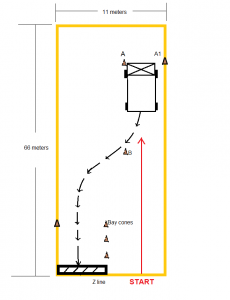
Handy hints and tips to help you pass your test….
Before the test
- Get to know the surrounding test area as you won’t be made aware of the route you will take on the day.
- Prepare the documents that you will need to bring along on the day – both parts of your driving licence and your theory certificate. Failure to bring these will mean the test will not go ahead.
- Make sure you are well rested – this is possibly the best advice we can give you!

Test Day…
- It might sound obvious, but wear something that you find comfortable and practical – especially footwear.
- When entering and exiting the vehicle always face forward using the steps and handrails.
- Again, like your regular driving test – always remember your mirrors and a blind spot at all times, specifically when you have been stationary and are about to move.
- Driving an HGV means that you need to allow more time to brake, factor this in when you meet traffic, especially other large vehicles. As an added note – the braking exercise will be practised on a public road.
- Always keep a mental note of the speed limit – safety is key.
- Be sure to lower your speed with your brakes, and choose the correct gear to continue driving.
- Use a marker as a reference point on your rear mudguard; this should give you a helping hand when you reverse into the specified area.
- Another tip for reversing – it may help to remove your seatbelt just before. But you must fasten it back straight after you’ve finished!
And finally – nobody is perfect! Remember that you can rack up to 15 minor faults and still pass your test.
