
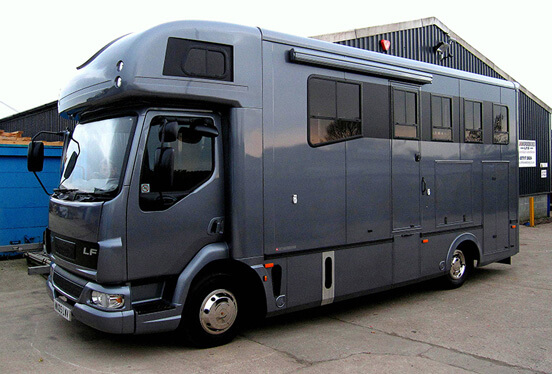
The horse lorry is a practical vehicle that makes transporting horses safe and convenient. But as with most other vehicles, there are different kinds of horse lorries to choose from. You could get something that is as basic as can be, with nothing more than the driving compartment and a large open area for horse stalls. On the other hand, you could get the equivalent of a luxury caravan with exclusive amenities in addition to a horse transport area.
Choosing a horse lorry is all about understanding your needs as a horse owner. Before you shop for a vehicle, ask yourself the following important questions:
- How often will I be transporting horses throughout the year?
- Do I transport horses for recreational purposes only, or do I do so commercially?
- How important are creature comforts to what I do?
- How long do I intend to keep the vehicle I choose?
- What can I realistically afford to spend on a horse lorry?
It is important to understand all of the different choices you have in horse lorries. Once you think you know what kind of vehicle you want to purchase, there are also driving licence requirements to consider. You will need at least a Category B+E licence; you may need one of the Category C licences and CPC certification as well.
Choosing Your Horse Lorry
A horse lorry is, in the eyes of the law, an HGV or LGV. This is true no matter how many bells and whistles you choose to add to the unit you purchase. In this respect, the horse lorry is distinctly different from the horsebox trailer in terms of both vehicle operation and the licence required. We assume you understand these differences as you shop for a horse lorry.
Your standard horse lorry with no extra frills consists of a lorry chassis on which is built the horse transport area and a driver cab. In the horse transport area, there will be one or more stalls along with a side or rear door and the necessary chattels to properly secure your animals and equipment. There will likely be windows as well. As for the cab area, it should be very similar to what you would find in a commercial LGV or HGV.

If you are looking for something more than just a basic unit, this sky really is the limit. You can choose from an extensive list of options, including:
- Separate storage area for equipment and feed
- Extra space for recreational vehicles
- Living, sleeping, and office space
- On-board electronics including computers and televisions
- Luxury interiors (including things such as leather dash, heated seats, GPS, etc.).
You can essentially build the horse lorry of your dreams if you have enough money. But consider this: every extra item you add to your unit also adds weight. Where you might be able to get away with a simple Category C1 licence on a basic unit, you may need a Category C+E licence if the weight of your lorry gets too high.
We will get to licence requirements in the next section. For now, what you need to know is that you should take plenty of time to shop around and ask questions before you purchase a horse lorry. Do not rush into a decision that could prove to be a disappointment in the near future. It is too big an expense to get it wrong.
Horse Lorry Licence Requirements
The size and weight of horse lorries indicate that they are usually too heavy to qualify under Category B and B+E licences. In rare exceptions, a lighter vehicle may be eligible to be driven with a Category B+E, but most will require one of the four Category C licences. Determining the licence you need requires knowing the weight and profile of your vehicle. The weight designations and their associated licences are as follows (note that we have only listed requirements as they apply to horse lorries):
- Category C1 – This licence is for vehicles weighing between 3.5 and 7.5 tonnes. Additionally, trailers of up to 750 kg can be towed using this licence. This would be for only the lightest horse lorries.
- Category C1+E – This licence is for drivers who want to operate a C1 vehicle with a trailer in excess of 750 kg. Under this licence class, the combination of both tow vehicle and trailer cannot exceed 12 tonnes.
- Category C – The Category C licence enables the driver to operate larger profile vehicles in excess of 3.5 tonnes, with or without accompanying trailers up to 750 kg.
- Category C+E – This licence is for large profile vehicles, with or without trailers in excess of 750 kg.
Many horse lorry drivers are confused by the Category C licences because of the unusual distinction relating to size (profile). Suffice to say that the first two licences listed above pertain to what the government considers medium-size vehicles. The last two pertain to large vehicles with bigger profiles. Practically speaking, the average horse lorry would fall under the Category C1 or C1+E licence. The other two are generally reserved for articulated lorries and vehicles of similar size.
We understand the driving licence requirements can be confusing. Therefore, we encourage you to contact us if you have any questions about what you need to do for safe and legal horse transport. The HGVT Training Services (HGV Training Centre) is committed to making sure all of our students meet the minimum legal requirements for transporting horses. We can provide the training you need to pass your Category C licence exam.
The Operators Licence for Horse Transport
Thus far we have dealt with licencing requirements for horse owners who only transport their animals for hobby or recreational purposes. This would include owners who may compete in organised events, but who do not derive a significant portion of their income from such competitions. As long as a horse owner maintains amateur status, no operator’s licence is required.
The operator’s licence is designed for those who transport horses for commercial purposes. For example, let’s assume you are a full-time horse trainer who contracts with owners to prepare their horses for racing. Part of your job involves transporting those horses from owner stables to training facilities. In your case, an operator’s licence would be required.
You would also need an operator’s licence if you were a horse lorry owner who hired out both your equipment and yourself for the purposes of transporting horses for others. If you derive a significant portion of your income from this activity, you are no longer considered an amateur. You are now a business owner who needs an operator’s licence.
Obtaining an operator’s licence requires undergoing CPC training as outlined by government regulations. Completion of that training includes an exam provided by an approved training facility. The HGVT Training Services (HGV Training Centre) is such a facility. We are an approved provider of CPC training for all driving licence classes.
Train with Us to Obtain Your Licence
If you own a horse lorry you use for any purpose, you will need to at least obtain the appropriate driving licence to operate it legally. If your horse lorry is used for commercial transport, you will also need an operator’s licence and CPC certification. We provide the training necessary for both types of horse transport.
As one of the largest and most diverse training companies in the UK, we have established a reputation throughout the industry for comprehensive training that our students can rely on regardless of the type of licence they seek to obtain. Furthermore, we enjoy a first-time pass rate in excess of 92% across all of the training classes we provide. Regardless of your purposes for obtaining a horse lorry licence, we have the training you need to get that licence quickly and conveniently.
More reading on Equestrian Transport in the UK
To find out more about what the HGVT Training Services (HGV Training Centre) can do to help you transport your horses safely and legally in the UK please select a heading from one of our articles below:
- What Licence Do I Need To Drive a 3.5 Tonne Horsebox?
- Find the Best Driver Training for HGV Horseboxes
- Find the Best Horse Box Trailer Towing Courses in Your Area
- Horse Lorry Types and UK Driving Licence Requirements
- The Best Intensive Training Course on Horse Trailer Towing
- The Easy Guide to Horse Transport Options in the UK
- The Simple Low Cost Solution to Getting Your Horsebox Licence
- How to Transport Horses Safely and Legally in the UK
- What Are The Licence Requirements For Towing A Horse Trailer?
- What You Need To Know About Towing Horse Trailers
